Report on the most appropriate way to repair a stone plinth Gillygate York
M. Womersleys were asked by the owner of a property on Gillygate as to the best way to repair the plinth stones on this building after initial proposals to use a cement-based render were rejected.
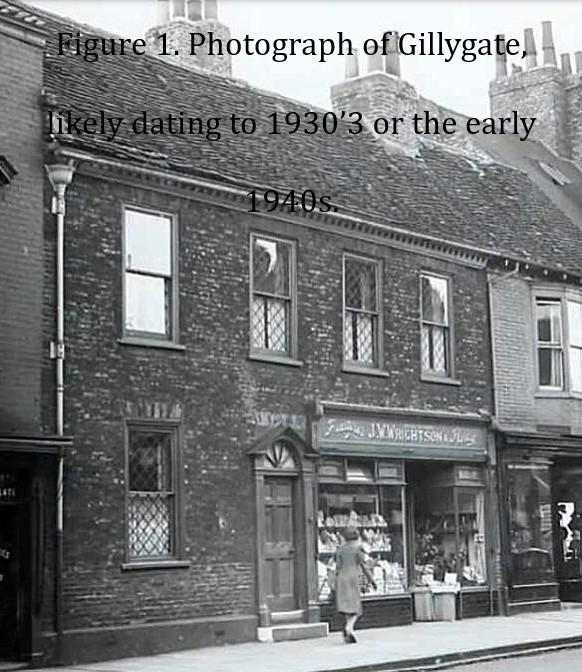
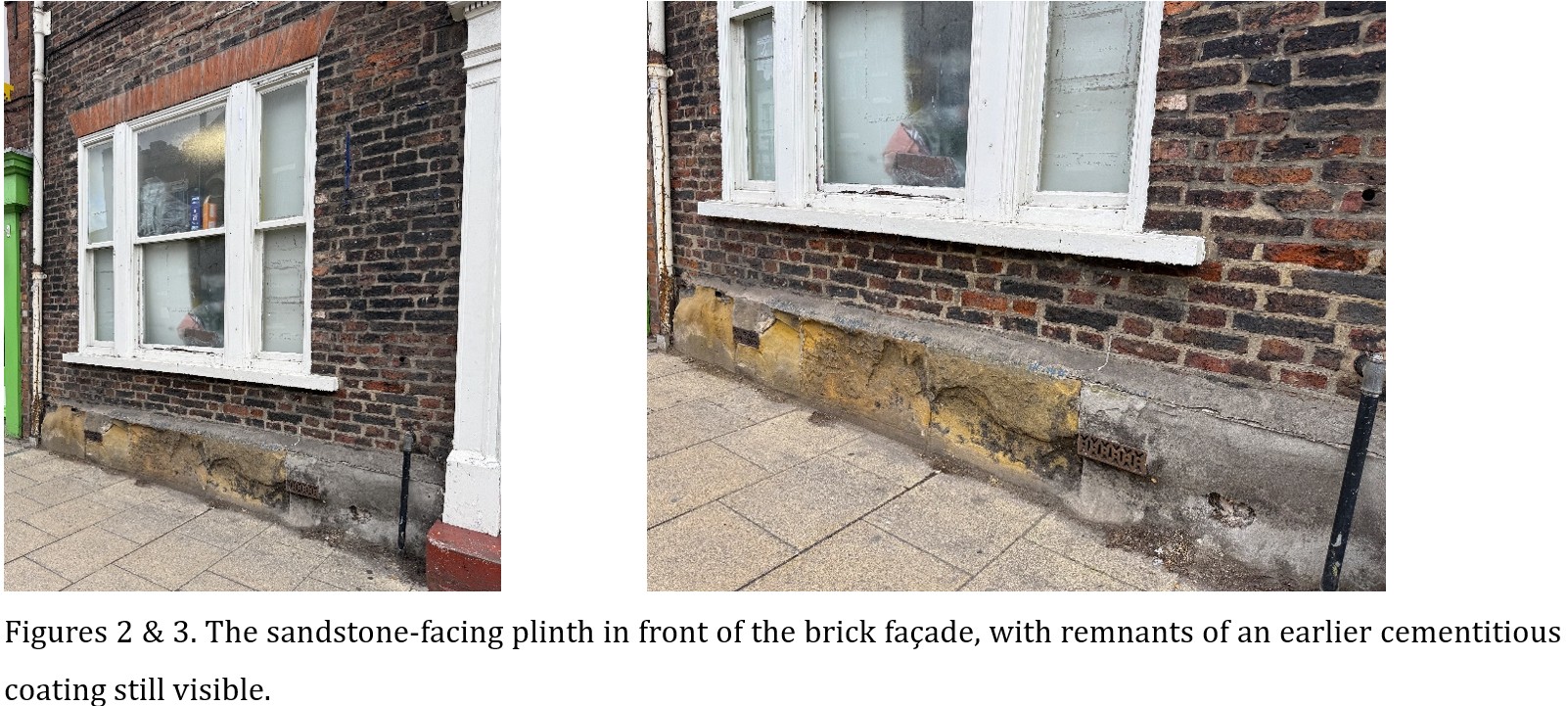
The building was ‘listed’ in 1971 when it was described as a house, now shops, c. 1770, with early C19 and C20 alterations. It was noted that on the ground floor the left-hand bay (now 70b Gillygate) has a tripartite sash without glazing bars, which is a late C20 insertion. There is no mention of the plinth, but a photograph in Figure 1, dated to the early 1940s, shows a painted, cemented plinth with air grates inserted. Below this, it is assumed that the later coatings were over a sandstone plinth, which is now visible. See Figures 2 & 3.
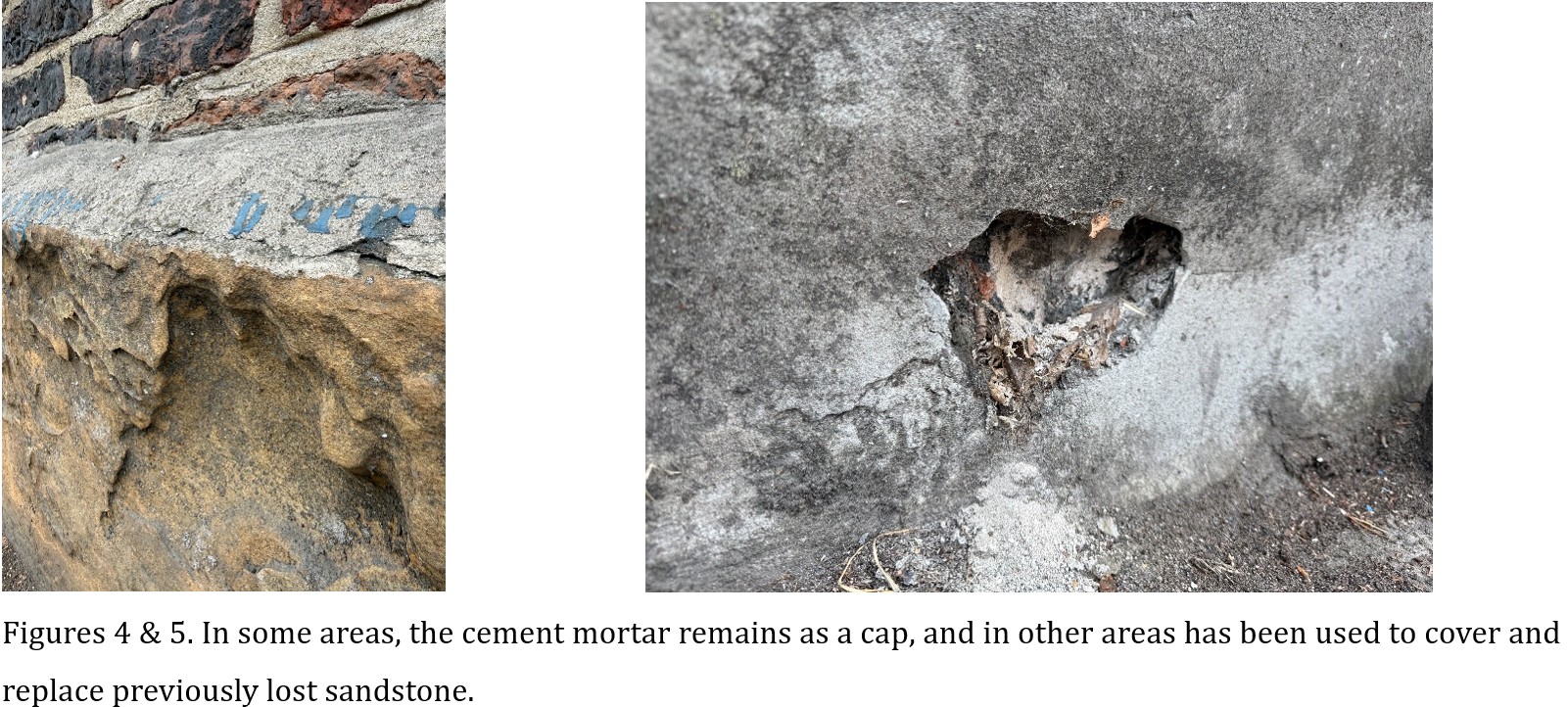
The sandstone appears to be bound by silica and consists of fine quartz grains, with the silica cementing them together. (Ashurst and Dimes 1998, 25) The stone plinth facing stones have been damaged by expansion and contraction due to temperature changes, frost, salt crystallisation, and careless work carried out before the building was ‘listed’; see Figures 4, 6 & 7.
The use of hard, impervious cement-based mortars has been a principal cause of stone decay in old buildings. (Odgers and Henry 2009, 57) At 70b Gillygate, whilst not the primary cause of decay, the strong cement repair mortars used on this building quite some time ago now have exacerbated the erosion of the stone plinth. Concentrating salt decay where the cement mortar meets the softer stone. See Figures 4 & 5. The principal source of these soluble salts is likely road and pavement de-icers used on this main road into the centre of York. The less soluble salts in this winter road treatment have crystallised within the pores of the stone (cryptoflorescence), causing the stone to powder. This effect is being exaggerated by the repeated wetting and drying of the stone at this vulnerable pavement-side location of the building.
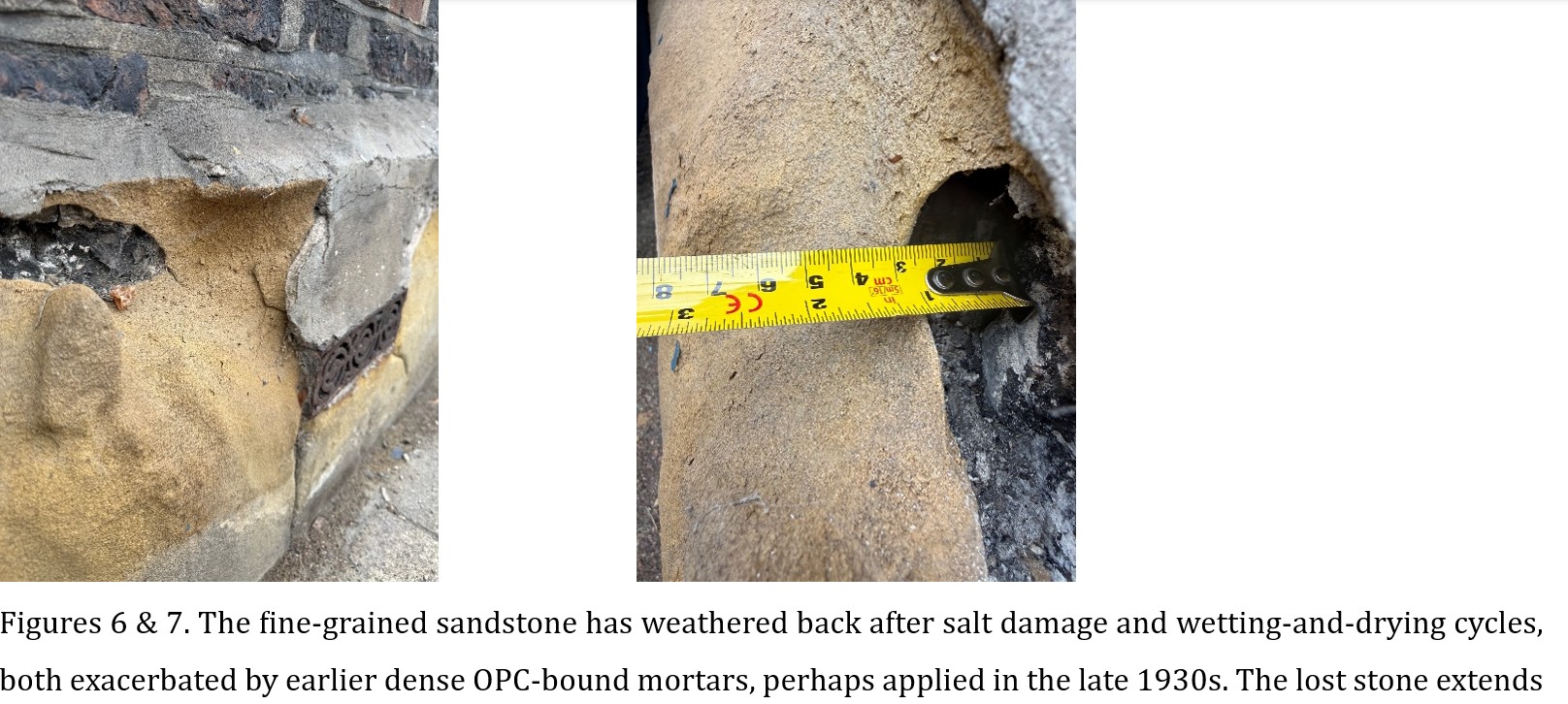
Although traditionally stones have been repaired with mortars comprising 1:2:6 and 1:2:9 cement-lime-sand mixes (Odgers and Henry 2009, 236), it has been recognised for the last few decades that hydraulic lime-based stone repair materials are more sympathetic and vapour-permeable, yet sufficiently set within themselves at depth in vulnerable damp locations. On no account should hot lime or lime putty mortars be used for stone mortar repairs where high porosity in the first 6-18 months will cause failure in locations at pavement level. Whilst armatures from the early days of stone repair have often been recommended for deeper build-ups of repair materials(Powys [1929] 1995, 80) the very weak nature and thickness of the remaining stone would mean that drilling into it would destroy large areas of the original fabric, and they should therefore not be used. See Figure 7.
Specifically, it is suggested that the following work be undertaken:
1. Carefully remove the existing cement capping from the left-hand three-quarters of the plinth and remove all loose and de-bonded remaining render from the right-hand quarter.
2. Use a mix of one part Socli Old White NHL3.5 and two parts sharp sand such as Nosterfield to fill behind the sandstone, where voids have been left by past erosion.
3. Remove the friable surface of the stone with non-ferrous metal brushes and use a scutch chisel to provide a key to the remaining cement render on the right-hand side.
4. Build out over two days Womersleys’ Lime-based Stone Repair described in the link below to re-create the original stone plinth depth and facing, to a colour that matches the original stone. https://www.womersleys.co.uk/shop/Stone_Repair_Mastics/womersleys-brick-stone-repair
5. Cut ashlar joints into the repaired plinth where they originally existed and point with a mix of one part Socli Old White NHL3.5 and two parts moist silica sand.
Within 12 hours, use a manual lion's-tooth carbide sanding plate on the lime-based stone repair material to restore the close-grained texture of the original sandstone plinth
Bibliography
Ashurst, John, and Francis G. Dimes, eds. 1998. Conservation of Building and Decorative Stone. Paperback ed. Butterworth-Heinemann Series in Conservation and Museology. Butterworth-Heinemann.
Odgers, David, and Alison Henry. 2009. Stone. English Heritage, Ashgate.
Powys, A. R. (1929) 1995. Repair of Ancient Buildings. J.M. Dent & Sons Ltd. Third. The Society for the Protection of Ancient Buildings.
Related Articles

New training course dates in December for those who wish to learn how to use lime for repointing, building and plastering
M. Womersleys provides more in-depth training courses in the use of lime for building, pointing and …

Anlysising historic renders and paints at Gregynog Hall
An initial render assessment together with mortar and paint analysis results. Buttress Architects, working…

A scheme for the repair of the listed Barn and Granary perpendicular to Lily Hall, June 2026
Introduction M Womersleys were asked to prepare a scheme for the repair of the listed barn …